
Marshall County Criminal Court Records
The Marshall County Circuit Clerk maintains criminal case files for the state trial courts. The file can include a complaint or warrant, arrest information, a charging paper, bond, advisements, pleas, motions, orders, grand-jury action or indictment, sentence, probation, costs, and final disposition. These records show the court process, not just the accusation at booking. The Marshall County arrest records and charge process focuses more closely on how a booking charge becomes a court charge.
District Criminal handles misdemeanors outside city limits, worthless checks, conservation tickets, revenue commission tickets, ABC violations, and felony cases at their starting stage. Felonies begin in District Court and remain there until grand-jury disposition. Indicted felony cases proceed in Circuit Court. Municipal courts maintain city misdemeanors and ordinance cases. The location and issuing agency therefore help identify the right custodian.
Search Marshall County Criminal Records
Alacourt ACCESS is the official paid trial-court record service. It offers name and case-number searches and can return a case detail with basic data, parties, court action, status, settings, financial history, and the case action summary. A search costs $9.99. Images, when available, are separately priced. The free county 58 docket can help locate a setting by date and last name, but it is not a complete criminal file.
- Decide whether the matter is a county case or a city municipal case.
- Search Alacourt by the exact case number when known, or by the defendant's full name.
- Confirm the court and division. An early felony record may be in District Court before a later Circuit Court file.
- Read every charge, plea, action, disposition, and sentence entry. Do not treat the first charge as the final outcome.
- Request a certified copy from the Circuit Clerk when an official document is required.
If online access fails, use the public computer in the Guntersville office of Circuit Clerk Angie Johnson. The official Circuit Clerk directory routes District Criminal to option 3 and Circuit Criminal to option 4 at (256) 571-7785. Court staff may report file information and schedules, but cannot give legal advice. A city case should be verified with the municipal court that handled it.
Marshall County Criminal Case Stages
The record grows as the case moves. A complaint, warrant, municipal complaint, prosecutor review, or grand-jury indictment can place charges before a court. Arraignment records the defendant's formal response. Pretrial entries may include bond, discovery, motions, subpoenas, hearings, or continuances. A plea or trial resolves contested charges, while disposition and sentencing record the result and consequences. Each charge may take a different path.
Case flow: Charges Filed › Arraignment › Pretrial / Motions › Plea or Trial › Disposition › Sentencing
- Charges Filed
- A complaint, information, indictment, or other charging instrument opens the accusation in court.
- Arraignment
- The defendant is advised of the charge and enters a plea.
- Pretrial
- Bond, discovery, motions, subpoenas, hearings, and continuances appear in the action summary.
- Plea or Trial
- The charge is resolved by an accepted plea, verdict, acquittal, dismissal, or other action.
- Disposition and Sentence
- The record states the result and any custody, probation, costs, restitution, or other terms.
What Marshall County Criminal Records Show
A full criminal court record is read field by field and event by event. The case number links contacts and copy requests to one file. The court tells whether the record is in District, Circuit, or Municipal Court. Charges show the accusations presented at a given stage. Pleas show formal responses. Court action entries record what was filed and ruled on. The disposition and sentence must be tied to the same charge because multi-count cases can end in mixed results.
| Field | What It Shows |
|---|---|
| Case Number | The court-assigned identifier used to locate and discuss the file. |
| Defendant | The person charged, with the role shown in the case caption. |
| Court / Division | District Criminal, Circuit Criminal, or a city municipal court. |
| Charges | The offense descriptions or codes as filed at that point in the case. |
| Bond | Bond entries and related orders; current bail should be confirmed with detention staff. |
| Plea | The defendant's formal response to each charge. |
| Docket Events | Motions, hearings, continuances, orders, grand-jury action, trial, and appeal entries. |
| Disposition | Guilty, acquitted, dismissed, transferred, or another final result for the charge. |
| Sentence | Custody, probation, costs, fines, restitution, or other ordered terms when applicable. |
Marshall County Charges vs Convictions
A charge is an accusation. A conviction is a result reached through a guilty plea or finding of guilt. Marshall County criminal court records can preserve charges that were amended, reduced, dismissed, or ended in acquittal. Booking data can also change after court. The official sheriff profile warns that charges and bail amounts may change after appearances and may not be current. Use the court disposition, not the arrest label, to determine the result.
| Charge | Conviction | |
|---|---|---|
| Meaning | An accusation brought before the court | A guilty plea or finding of guilt |
| Where shown | Charging instrument and early docket | Disposition, judgment, and sentence entries |
| Can change? | May be amended, reduced, dropped, or dismissed | May be reviewed through post-judgment or appeal procedures |
| How to verify | Read later actions for the same count | Obtain the final order or certified disposition |
Read Marshall County Case Outcomes
Read the disposition beside each charge. “Guilty” reflects a conviction. “Not guilty” or an acquittal means the prosecution did not obtain a conviction on that count. “Dismissed” means the charge ended without a conviction in that case, though the reason and any later filing should be checked. A transfer can move the matter to another court rather than end it. “Pending” means no final outcome is shown.
Sentence entries should be read with the final judgment. They may include custody, probation, fines, court costs, restitution, or conditions. Financial history may show amounts and payments, but the current balance should be confirmed with the clerk. An appeal or later order can alter the result. For a felony, compare the early District Court record with the later Circuit Court file so the grand-jury transition is not mistaken for dismissal.
Sealed vs Expunged Criminal Records
Sealing and expungement both limit ordinary public access, but they are not identical. A sealed record remains in court custody under a restriction. Alabama expungement law allows petitions for eligible matters under stated conditions and removes granted records from ordinary public criminal-history channels. Neither status should be described as destroying every government record or blocking every authorized use.
| Sealed | Expunged | |
|---|---|---|
| Public visibility | Withheld under law, rule, order, or sealing | Removed from ordinary public access after a granted petition |
| Government access | May remain available to authorized users | Statutory exceptions may preserve authorized access |
| How obtained | Depends on the court rule, law, or order | Petition under Alabama Chapter 15-27 for an eligible matter |
| Correction path | Contact the clerk about the sealing order | Provide the maintaining office a certified expungement order if the public entry remains |
The Alabama expungement eligibility statute addresses certain misdemeanors, violations, traffic charges, and municipal ordinance matters. Its official presentation is a useful source for Marshall County criminal records.
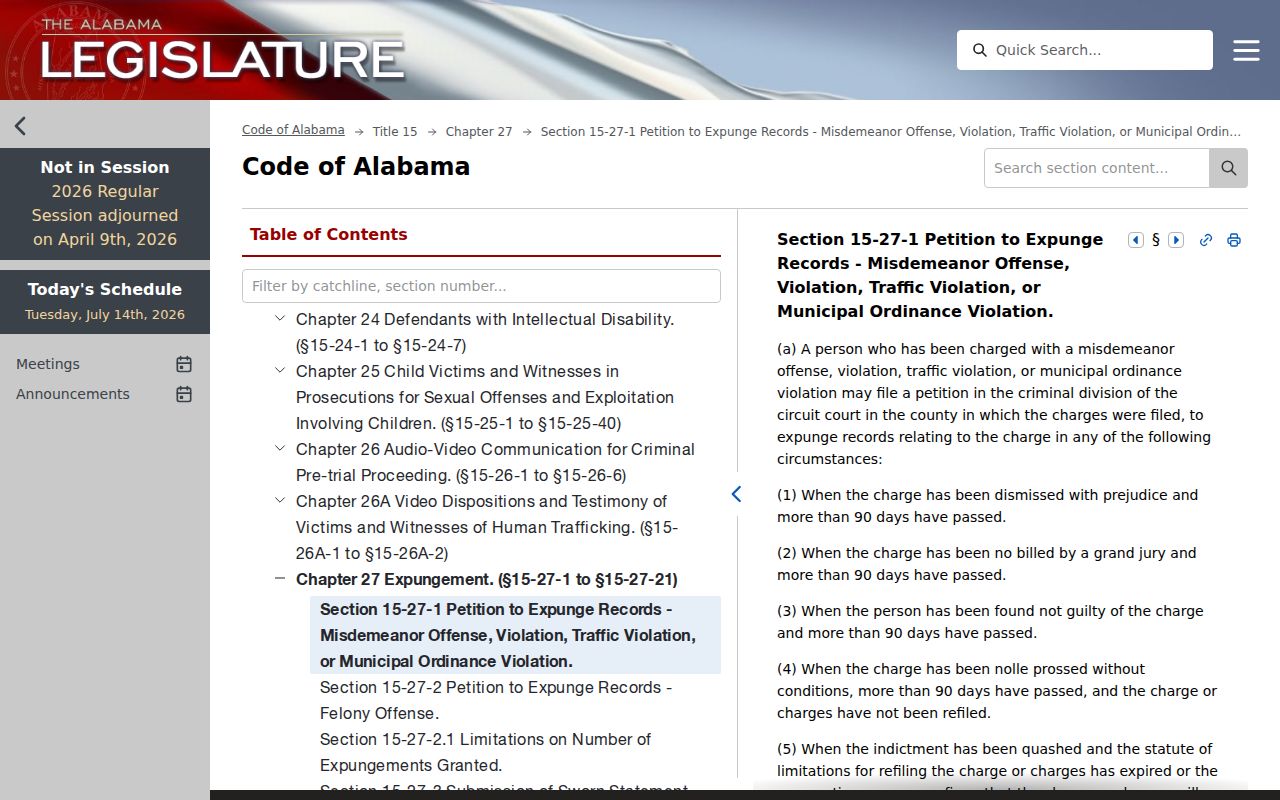
The statute requires a case-specific eligibility review rather than a promise that any charge can be expunged.
Public Marshall County Criminal Records
Alabama Code Section 36-12-40 supports resident inspection and copying of public writings unless another law makes the record exempt. Court-Record Privacy and Confidentiality Rule 104 treats court records as accessible unless sealed, confidential, restricted by law or rule, or restricted by court order. These rules support ordinary access but preserve the restrictions that apply to protected criminal files.
Key Statutes:
Alabama Code Section 36-12-41 requires a copy on proper request and payment of a reasonable fee.
Alabama Code Section 12-15-133 makes juvenile legal and law-enforcement records confidential except for authorized access.
Verify Marshall County Criminal Results
A name match is not enough to identify a person. Compare the court, case number, filing history, and the outcome of each charge. A criminal court record is also different from a county jail booking and from a statewide criminal-history product. Federal custody and courthouse questions use separate channels, including the U.S. Marshals Service Northern District locations. For employment, housing, credit, insurance, or another regulated decision, use a lawful and appropriate consumer-reporting process. A casual public court lookup should not be repurposed for an FCRA-regulated decision.
Important: This privately operated resource is not a consumer reporting agency and cannot supply an FCRA-compliant background report.
Restricted Marshall County Criminal Records
Juvenile cases are not ordinary public criminal files. Alabama Code Section 12-15-133 limits their release to authorized persons and uses. Sealed and expunged cases may also be absent from public search. Personal identifiers can be redacted, including full Social Security numbers, account numbers, and protected minor information. The court's privacy rules, a statute, or a specific court order may limit other data.
The official juvenile confidentiality law shows why a public Marshall County criminal case search does not include juvenile detail.
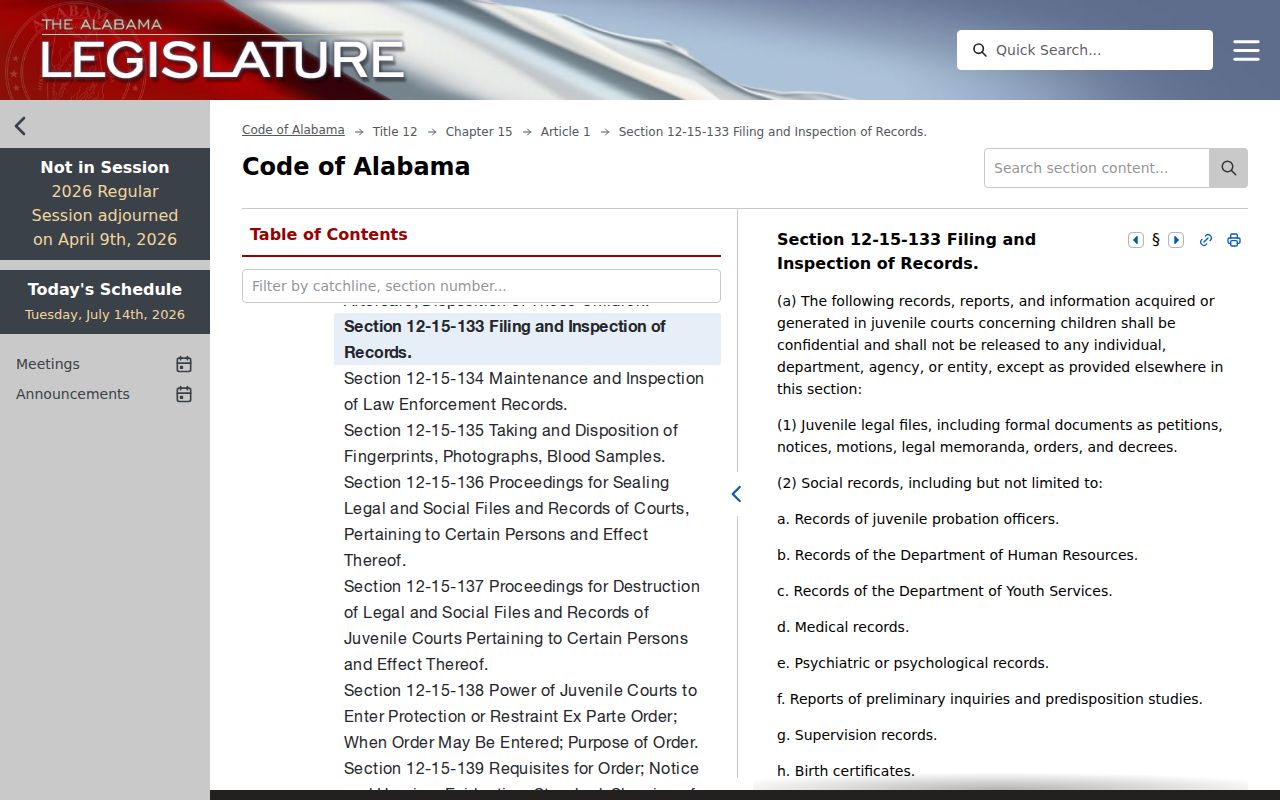
The law directs protected access through authorized channels rather than a public portal.
For an authorized request, contact the court that maintains the file and describe the legal basis for access. The Guntersville Circuit Clerk is inside Marshall County Courthouse at 424 Blount Avenue, Suite 201, and can be reached at (256) 571-7785. The Marshall County court site confirms the local clerk channel and weekday hours. Sheriff Phil Sims leads the separate Marshall County Sheriff's Office; sheriff booking or investigative data should not be mistaken for the criminal court file. Municipal restrictions and requests belong with the relevant city court.